
A Deeper Look at Belief, Consequences, and the Hidden Structure of Life
Introduction: The Question Most People Avoid
Imagine this.
You’re standing in a quiet room with someone you trust. You hand them a drink. You look them in the eye and tell them it’s safe. They hesitate for a second… then they drink it.
Moments later, their body gives in. It was poison.
Now pause.
Who is responsible?
Was it the person who drank it?
Or the one who influenced them?
Most people, when they are honest, arrive at the same conclusion:
Both are responsible but not equally.
Because something deeper is at play here.
Influence.
Belief.
Perception.
What we accept as true doesn’t just stay in our minds. it quietly shapes how we act, what we justify, and what we are willing to ignore.
And that leads to a much bigger question:
What happens to human behavior when we change what we believe about consequences?
Atheism, Simply Defined—and Why That’s Not the End of the Story
Atheism, in its simplest form, is straightforward:
It is the absence of belief in a god or higher divine authority.
No commandments.
No divine judgment.
No supernatural accountability.
On the surface, this seems clean. Rational. Even freeing.
It places responsibility directly in human hands:
- Laws define right and wrong
- Society enforces consequences
- Reality responds through cause and effect
Nothing mystical. Nothing hidden.
But here’s where most conversations stop too early.
Because removing a higher reference point doesn’t just remove belief—it reshapes perception.
And once perception shifts, behavior quietly follows.
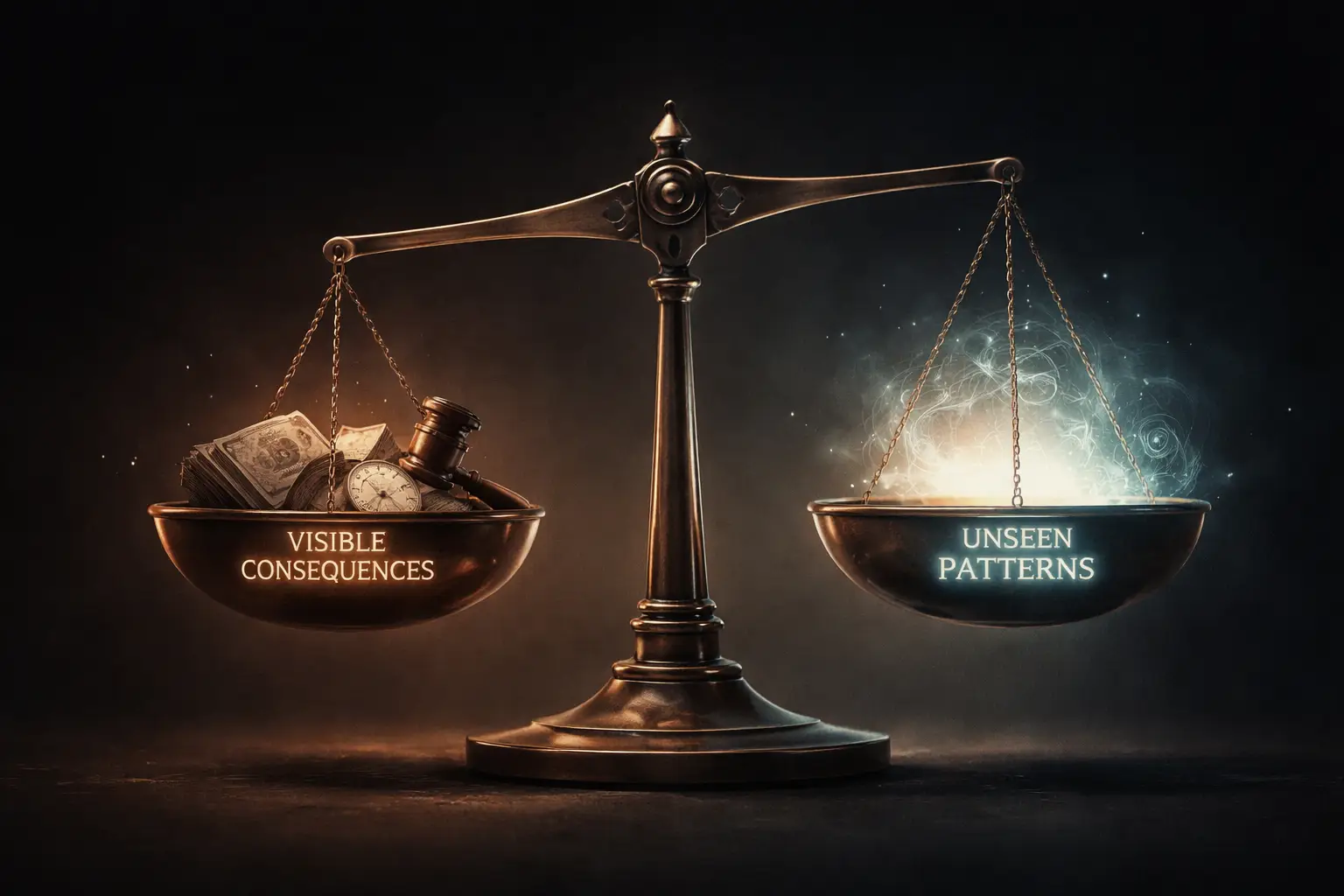
The Subtle Shift: When Consequences Become Only What You Can See
Picture life as a system of feedback.
You act and something responds.
Now imagine two versions of that system:
Version One
Only what is immediate and visible counts:
- You break a rule → you get punished
- You avoid detection → nothing happens
Version Two
Some consequences are immediate.
Others are delayed.
Some are internal.
Some unfold over time in patterns you don’t fully see at first.
Now ask yourself honestly:
Which version feels closer to real life?
Most people have experienced this:
- A decision that seemed harmless… but came back later
- A habit that slowly shaped their future without them noticing
- A choice that left a weight—not because anyone punished them, but because it stayed with them
Yet, when a worldview reduces consequences to only what is visible, something begins to shift:
- Morality becomes negotiable
- Responsibility becomes situational
- And the central question changes from
“Is this right?”
to
“Will anything happen to me if I do this?”
Not in everyone.
But often enough to matter.
The Poison Analogy Revisited: Why Belief Is Never Neutral
Let’s return to the earlier scenario.
The person who drank the poison made a choice. That’s true.
But the one who influenced them shaped that choice.
Now extend this idea beyond a single moment—to a lifetime of beliefs.
If a person grows up internalizing that:
- There is no deeper layer of consequence
- Nothing beyond immediate cause and effect
- No unseen pattern or moral structure beyond human systems
Then over time, their lens narrows.
Consequences become:
- What is enforced
- What is visible
- What is immediate
Everything else becomes… irrelevant.
So the real question is not:
“Does atheism tell people to behave badly?”
Because it doesn’t.
The real question is:
“What happens when people only recognize the consequences they can see?”
Let’s Be Honest: This Is Not Just an Atheism Problem
Before going further, let’s be clear.
This issue is not exclusive to atheism.
Religion can create the same distortion—but in a different form.
- “I can be forgiven later.”
- “I can repent after the fact.”
In this case, consequences are not denied—they are postponed or softened.
So on both sides, the same human tendency appears:
The tendency to psychologically reduce the weight of our actions.
That’s the real issue.
Not atheism.
Not religion.
But how humans interpret and use belief systems.
The Real Problem: Shallow Interpretations of Reality
Here is the uncomfortable truth:
Most people do not deeply examine their worldview.
They simplify it.
And when complex ideas are simplified too much, depth is lost.
Atheism, in its strongest form, is not shallow. It is rigorous, analytical, and grounded in evidence.
But in everyday life, it can become reduced to something much simpler:
“If I don’t see it, it doesn’t matter.”
That is not philosophy.
That is reduction.
And reduction, when applied to life, creates blind spots.
Cultural Depth: Why This Feels Different in Some Societies
In many cultures—especially across African traditions—life has never been understood as purely mechanical.
It is seen as:
- layered
- interconnected
- meaningful beyond immediate events
Actions are not isolated.
They ripple through:
- family
- community
- identity
- and time
In such a context, a worldview that reduces life to only what is visible can feel… incomplete.
Not necessarily wrong.
But insufficient.
Like describing the ocean by only looking at its surface.
Pragmatic Spiritualism: A More Complete Lens
So what’s the alternative?
Not blind faith.
Not rigid doctrine.
Not denial of logic.
But integration.
Pragmatic Spiritualism
Pragmatic Spiritualism is a framework that accepts:
- Reality is practical → actions have observable consequences
- Reality is layered → not all consequences are immediate or visible
- Human beings are responsible → choices shape outcomes deeply
- Life operates in patterns → behavior creates long-term structure
It does not ask you to:
- abandon logic
- follow dogma
- submit to authority
But it also does not reduce life to:
- randomness
- or surface-level cause and effect
Instead, it invites a more grounded question:
What if life is both rational and deeper than we fully perceive at once?
A Simple Reflection
Think about your own life. not theory, not ideology.
Real life.
- The decisions that shaped you
- The habits that built you or broke you
- The moments that stayed with you long after they passed
Were all consequences immediate?
Or did some unfold slowly… quietly… over time?
A More Complete Understanding of Consequences
Let’s strip everything down to its essence:
- Some people believe consequences are only visible
- Some believe they can be forgiven or erased
- But reality suggests something else
Consequences are often embedded in the structure of life itself
Not as punishment.
But as pattern.
Final Thought: What Are You Choosing to See?
This is not about labels.
Not atheism.
Not religion.
It’s about perception.
Are you seeing only what is immediate?
Or are you open to the possibility that life carries depth beyond what is instantly visible?
Because whether we acknowledge it or not—
our actions leave traces.
In outcomes.
In patterns.
In who we become.
Conclusion: Depth Over Simplicity
Atheism is not evil.
Religion is not perfect.
But both can become limiting when interpreted without depth.
The real challenge is not choosing sides.
It is choosing awareness.
Choosing to see more than what is obvious.
Choosing to think beyond what is convenient.
And ultimately—
Choosing to live as if your actions truly matter,
even when no one is watching.